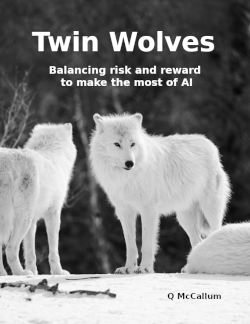
My latest book: Twin Wolves: Balancing risk and reward to make the most of AI
Here are the top ten ways execs sabotage their company's AI transformation. How does your company stack up?
Give yourself a point for each of the following:
▶️ 1: You skipped data fundamentals ◀️
You dove straight to genAI, before exploring BI / data science / ML and before establishing data governance.
▶️ 2: You skipped AI literacy ◀️
You issued company-wide mandates to use genAI, without understanding what the technology can/cannot do.
▶️ 3: You're winging it ◀️
Instead of developing a solid AI strategy (a proper road map, not just a mission statement) you went full YOLO™ on AI adoption.
▶️ 4: You're over-delegating ◀️
You decided that the company will adopt genAI, but then went completely hands-off and left the details to everyone else.
▶️ 5: You're under-delegating ◀️
You are so excited about genAI that you focus on technical minutiae and miss the strategic aspects of AI adoption.
▶️ 6: You're only thinking of the upside ◀️
You conveniently forget that genAI's potential upside is a package deal with its potential downside.
▶️ 7: You're only thinking of the downside ◀️
You're so focused on what can go wrong with genAI that you shun the technology altogether.
▶️ 8: You keep your technical teams in the dark ◀️
You have in-house AI experts but you make AI plans without looping them in.
▶️ 9: You expect software-like predictability ◀️
You treat (probabilistic) genAI systems as though they are (deterministic, predictable) software systems … and then wonder why there are so many problems.
▶️ 10: You're using AI when it's not a good fit ◀️
You replace tools and cut headcount without first confirming that genAI is capable of the task at hand.
Be honest: how did you do?
Scoring even one point indicates a problem. If you scored three points or higher … reach out.
(For a longer version, you can check out the post on my website. I also encourage you to check out my latest book: Twin Wolves: Balancing risk and reward to make the most of AI. This is a short, executive-level guide on approaching AI with a mindset of risk-taking and risk management.)